Growing Humanity in Schools
An Introductory Program Designed for Parents
Empower Your Child by Empowering Yourself
This 4-part course package is thoughtfully designed to help parents navigate the complexities of school, so they can feel empowered to build on their child’s strengths within the strengths of their communities. You will learn how to:
🌱 use the power of stories to influence what your child sees
🌱 help your child find places in school worth connecting to
🌱 help your child find reasons to try
A child’s engagement in school and motivation are shaped not just by what happens in the classroom—but also by how they interpret their experiences.
Discover how to bring out the best in what
makes all of us human
Program Syllabus
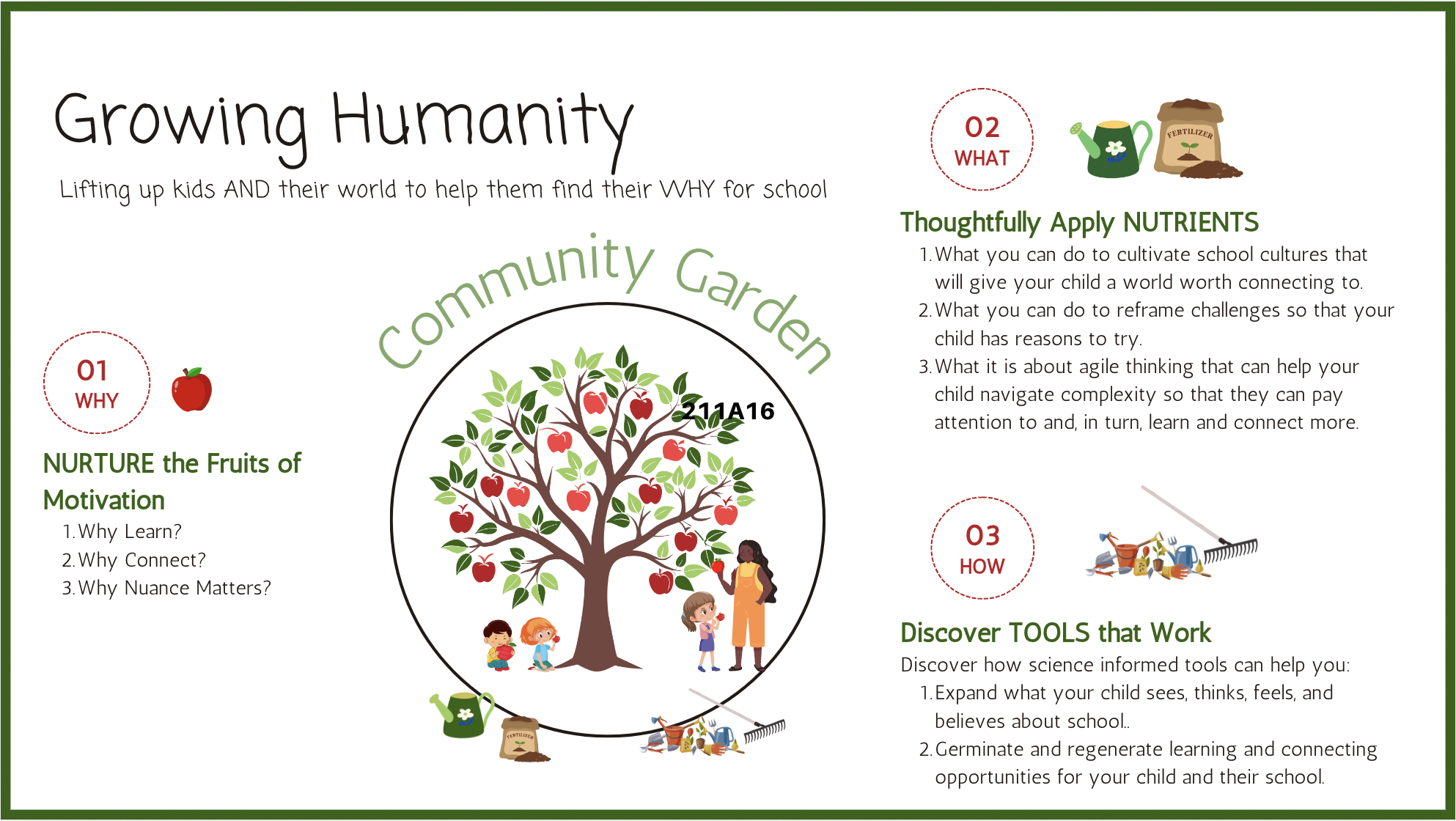
Intentionally Take a More Interconnected Approach
PART 1:
Use The Power of Stories to Influence What Your Child Sees
Stories have been used for centuries to evoke emotions in people and, in turn, influence how they think, feel, believe, and—ultimately—how they behave. Less talked about, however, is the content of our stories and how the framing of our narratives could impact kids and their schools. Discover how you can intentionally take a more interconnected approach to influence what it is that your child pays attention to.
part 2:
help your child find a world worth connecting to
As humans, we are inherently imperfect, and at some point, learning and belonging can feel burdensome. That’s why it’s essential to cultivate school environments where students—and their teachers and parents—can have meaningful, and sometimes challenging, conversations. Organizations that foster cultures built around engagement, curiosity, and open communication not only enhance accountability and performance but they also spark creativity while reducing burnout and attrition. Explore the science that will help you to support your child in finding places in school worth connecting to.
part 3:
help your child find reasons to try
Challenges are an inevitable part of life, and our ability to navigate them is shaped by how we perceive and respond to them. Discover how you can help your child reframe their challenges so that they can be empowered with their WHY—why learn, why connect. Your WHY fuels your purpose and shapes your beliefs and, as humans, we have a deep psychological need to learn and belong. Explore the science that can help you support your child in finding meaningful reasons to try.
part 4:
help your child INTENTIONALLY MAKe SPACE FOR POSSIBILITIES
As humans, we all have hidden biases (cognitive biases) and thinking shortcuts (heuristics) that can limit what we pay attention to, which, in turn, can influence how our opportunities unfold. By understanding what your cognitive biases and heuristics are and how they impact you personally, you can then adopt strategies to challenge the ways that you and your child think—so that you can both pay attention to more. Discover how to create realistic messages around possibilities rather than constraints.
We Offer Applied Learning
That is Unique to Our Program
Classroom learning is meaningful, but how you apply it also matters. That’s why we offer you the option to receive regular online nudges to enhance your understanding after the formal classroom learning is over. These concise, science-backed questions will encourage you to reflect on and expand your thinking, enabling you to enhance your ability to support your family.
Engagement Options
🌱 Individual: Receive personalized prompts privately.
🌱 Group: Engage with prompts alongside friends, creating a private community lounge for guided discussions, either in person or asynchronously through our online platform.
🌱 School-Wide: Participate in prompts as an entire class or school community, fostering a unified approach to supporting the parent-student-teacher triad.

🌱 What seeds are you planting….
Is your child focusing on what is wrong?
My teacher said [an unkind comment] but
🌱 my parents didn’t give up on me.
is your child learning and connecting?
My teacher said [an unkind comment], at which point
🌱 my parents took a deep breath and embraced humility and curiosity.
🌱 They asked questions.
🌱 Their goal was to find meaningful resources and strategies for everyone involved.
🌱 In the process, we all felt interconnected and supported, and—in the end—we all learned more.
do you ask questions as an external player?
Why don’t they teach [this new concept] in schools?
do you use curiosity to learn and connect?
I wonder if they teach [this new concept] in our school and how I can support my child/teacher.
ARE YOU being CRITICAL in how you evaluate SCHOOLS?
When I was in school, the format was top-down, rigid, and hierarchical. I’m going to share on social media the number one TED Talk of all time, Do Schools Kill Creativity, with over 77 million views.
Can you CRITICALLY stretch your THinking?
If schools do [X] and you are a [Y] type of student, your creativity might be impacted. That would be a good opportunity to talk with your teacher about doing [A or B].

🌱 Ask yourself, as a parent,
when your child encounters challenges at school, do you tend to focus on possibilities or constraints…